
The woodland cycle
What's happening in there? What are the layers within a woodland and how do they interact?
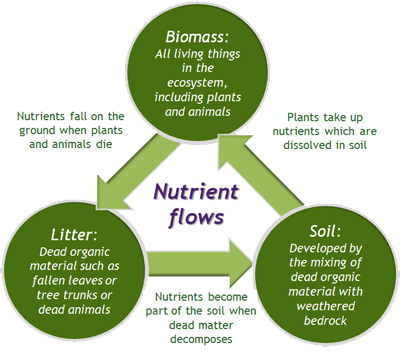
British woodlands are made up of mostly deciduous trees – these drop their leaves in autumn and grow new ones in spring. When the leaves drop they breakdown and decompose, this provides fertile growing material, helping new plants to grow.
Decomposition is an active process. After leaves fall, their water content is lost. Then, leaves are physically fragmented by soil invertebrates like earthworms. Fungi and and insects can also be involved. Further breakdown happens at a much smaller level, where microbes chemically change the dead material, releasing essential plant nutrients and carbon dioxide as waste products.
Examples of deciduous trees found in the British woodlands are oak, ash and birch – all grow to around 20 to 30 meters high and help form the canopy layer (that's the height of two double-decker busses!). Smaller trees and shrubs occupy the more sheltered lower levels, but their growth is more restricted due to receiving less light.
The soil which anchors all of these plants in the ground is known as brown earth: it is mildly acidic and very fertile due to all the decomposition that takes place.